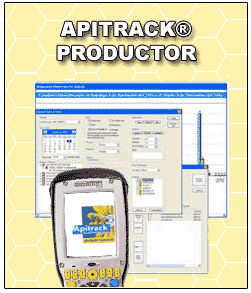
Apitrack — Beekeeping Industry Traceability System
Description
A first-generation food chain traceability software engineered specifically for the beekeeping industry. Apitrack was the pioneering system to implement RFID tags directly on beehives and integrate industrial-grade data collectors with barcode labeling for end-to-end production tracking. The solution covers the entire apicultural value chain — from individual hive identification through extraction, packaging, storage, and final consumer delivery — while ensuring compliance with international food safety regulations including Argentina's Res 857-2006, Res 870-2006, and Denominación de Origen (Ley 25.380).
Development began in 2003, making it one of the earliest commercial applications of RFID in agriculture. The system has been deployed across Argentina, Chile, Uruguay, Spain, and export markets to China and the United States.
Technologies used
- C#.NET
- MySQL
- .NET Framework
- Windows CE / Windows Mobile
- PSION TEKLOGIX / DATALOGIC / INTERMEC Data Collectors
- RFID (Honeywell/Intermec)
- Barcode Labeling (ZEBRA Thermal Printers)
- RS232 Industrial Scales Integration
- Web-Based Public Traceability Portal
Responsibilities
- Product owner
- FullStack developer
- Field Collector App Main developer
- System Architect
Business Impact
- Industry Pioneer: First system worldwide to deploy RFID identification on beehives, setting a new standard for apiculture traceability.
- Regulatory Compliance: Enabled producers to meet and exceed national food safety regulations (Argentina Res 857-2006, Res 870-2006, SENASA/SAGPyA requirements) and international export standards.
- End-to-End Visibility: Tracked honey from individual hive through extraction, fractionation, storage, and consumer delivery — eliminating manual paper-based record-keeping.
- Multi-Language Deployment: Supported operations across 6+ countries with Spanish, Portuguese, and English interfaces.
- Scalable Architecture: Managed up to 199 warehouses with 1,999 distinct items per location without performance degradation.
Regulatory Compliance
The system was engineered to comply with multiple national and international regulatory frameworks:
- Argentina: Res 857-2006 (Apicultural Production), Res 870-2006 (Extraction Rooms), SAGPyA/SENASA guidelines, Ley 25.380 (Denominación de Origen)
- Chile: SAGC regulations, Resolución 178/2002, Resolución 852/2004, Resolución 1935/2004, Resolución 1664/2006
- European Union: CODEX Alimentario standards, Spain traceability guidelines, Germany import requirements
- International: Uruguay JUNAGRAV compliance, China and USA import regulations, organic production standards
Key Features
- Hive-Level Identification: Each beehive receives a unique identifier via RFID tag or barcode label, creating a permanent digital record that follows the hive throughout its lifecycle.
- OPP Weather-Resistant Labels: Custom OPP (Oriented Polypropylene) labels engineered to withstand rain, UV exposure, propolis adhesion, and extreme temperatures (-25°C to 85°C) in outdoor apiary conditions.
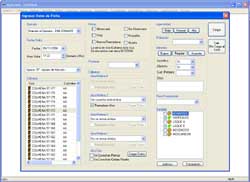
- Multi-Stage Production Tracking: Dedicated modules for each stage of the honey production chain — field data collection, extraction, fractionation/packaging, and warehouse management — with full data continuity between stages.
- Public Web Traceability Portal: Consumers and inspectors can query any drum or container code to view the complete production history, from hive origin to final product batch.
- Third-Party Processing Management: Extraction facilities can track material received from external producers, manage processing accounts, calculate service fees, and maintain transparent billing records.
- Offline-First Field Collection: Industrial data collectors operate without network connectivity in remote apiaries, storing data locally and synchronizing when connectivity is available.
- Statistical Reporting & Analytics: Automated generation of production reports, health monitoring summaries, yield analysis, and regulatory compliance documentation.
Learned
- Agricultural Hardware Durability: Outdoor RFID tags and barcode labels in apiaries face unique environmental challenges — propolis adhesion, humidity, temperature swings, and UV degradation. OPP labels with industrial adhesives and IP67-rated RFID identifiers (10+ year lifespan) proved essential for long-term field reliability.
- Industrial Equipment Integration: Connecting RS232 scales, thermal barcode printers, and legacy data collectors to a unified software system required robust serial communication handling, data validation, and error recovery mechanisms.
- Regulatory-Driven Architecture: Designing a traceability system that satisfies multiple national food safety regulations simultaneously required a flexible data model that could accommodate varying reporting requirements, terminology, and compliance checkpoints.
- Multi-Language International Deployment: Supporting operations across Spanish, Portuguese, and English-speaking markets from a single codebase required careful internationalization of the UI, reporting templates, and regulatory document generation.
- Zero-Loss Data Integrity: The agricultural supply chain cannot tolerate lost records. Implementing non-deletable records with mandatory audit trails and forced reconciliation processes ensured data integrity across all production stages.
Architecture
graph TB
    HIVE[<b>Individual Hives</b></br>RFID / Barcode]
    COLLECTOR[<b>Field Data Collectors</b></br>PSION / DATALOGIC / INTERMEC</br>Windows CE / Mobile]
    EXTRACT[<b>Extraction Room</b></br>Drum Scales / RS232 / ZEBRA Printers]
    PACK[<b>Fractionation / Packaging</b></br>EAN Labeling / Batch Tracking]
    WAREHOUSE[<b>Warehouses / Storage</b></br>Multi-location Asset Mgmt]
    WEB[<b>Web Traceability Portal</b></br>Public Consumer Access]
    DB[<b>Central Database</b></br>MS SQL Server]

    HIVE --> COLLECTOR
    COLLECTOR --> DB
    DB --> EXTRACT
    EXTRACT --> DB
    DB --> PACK
    PACK --> DB
    DB --> WAREHOUSE
    WAREHOUSE --> DB
    DB --> WEB
    WEB -.-> HIVE
Components
-
Field Data Collection
- Hive Identification: Each hive tagged with unique RFID or barcode identifier — first system to implement RFID on beehives.
- Health & Visit Logging: Record inspections, queen status, honey yields, treatments, and seasonal data directly in the field.
- Weather-Resistant Labels: OPP labels with industrial adhesives withstand rain, UV, propolis, and temperatures from -25°C to 85°C.
- Offline Operation: Full functionality without network connectivity; queues data for later synchronization.
-
Extraction Room Module
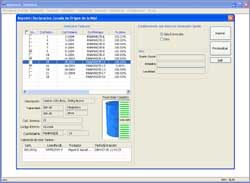
- Drum Weight Integration: Direct RS232 connection to 600kg industrial scales for automatic weight capture.
- Third-Party Processing: Manage accounts for external producers — track received honey, extracted yield, service percentages, and billing.
- Drum Identification: Register empty drums, track their lifecycle, and print barcode labels for full traceability.
- Automated Reporting: Generate extraction reports, service invoices, and regulatory compliance documentation.
-
Fractionation / Packaging
- EAN Code Linking: Associate each package's EAN code with production batches for complete traceability back to the hive.
- Multi-Container Support: Package from decantation tanks or directly from drums using any container type.
- Batch Management: Create and track production batches throughout the packaging process.
- Packaging Statistics: Generate reports by container type, date, and batch for quality control and inventory management.
-
Warehouse & Storage Management
- Multi-Location Tracking: Manage up to 199 warehouses with 1,999 distinct items per location.
- Asset Transfer Control: Track materials loaned to fields or third parties — no more lost inventory.
- Barcode Label Printing: Generate and print labels for all inputs, outputs, and stored items using ZEBRA thermal printers.
- Audit-Proof Records: Non-deletable records with mandatory reconciliation ensure complete audit trail integrity.
-
Public Traceability Portal
- Consumer Query Interface: Anyone can trace any drum or container by entering its Apitrack code, drum code, EAN, or batch number.
- Complete Production History: Displays the full journey from hive origin through extraction, processing, and packaging.
- Regulatory Transparency: Provides inspectors and certifiers with instant access to compliance documentation.
- Multi-Language Support: Available in Spanish, Portuguese, and English for international markets.
Main advantages
First-Mover RFID in Apiculture
Pioneered the use of RFID tags on beehives, establishing a new paradigm for apiculture traceability that predated widespread adoption in the industry by years.
Complete Supply Chain Coverage
Unlike fragmented solutions, Apitrack covers every stage of the honey production chain — from hive to consumer — with seamless data continuity and no manual data re-entry between stages.
Regulatory-First Design
Built from the ground up to satisfy multiple national and international food safety regulations simultaneously, making it a turnkey solution for producers targeting export markets.
Industrial-Grade Field Hardware
Integrated with purpose-built industrial data collectors (PSION TEKLOGIX, DATALOGIC, INTERMEC) designed for harsh outdoor conditions, glove-friendly operation, and extended battery life in remote apiaries.
Deterministic Data Integrity
Non-deletable records, mandatory audit trails, and forced reconciliation processes ensure that once data enters the system, it cannot be lost or altered without trace — critical for food safety compliance and consumer trust.
Images
Photos